

The arrival of a premature baby in the Neonatal Unit is a far from unusual occurrence but ‘Paul’ is not a usual baby and he is causing real excitement.
Paul is a manikin purchased by the Trust, to be used for training purposes. He replicates a baby born at 27 weeks and three days (normal pregnancy term is 40 weeks). He is not only amazingly realistic, he also comes with an astonishing amount of cutting edge technology that will allow nurses and doctors to practise a range of scenarios and simulated medical conditions. He can even be hooked up to the monitors used for real babies.

‘It is going to be an amazing training tool,’ says Angela Albistion, Lead Advanced Neonatal Nurse Practitioner, ‘we can make him “unwell” and run through scenarios, then we can do a debrief afterwards and leave everyone feeling a more confident.’
The manikin is perfect for practising the use of a video laryngoscope, recently purchased by the Friends of Noble’s Hospital for the Neonatal Unit. A laryngoscope is used to facilitate the intubation of a patient, for example to insert a breathing tube or carry out resuscitation.
The video laryngoscope is connected to a screen that gives an enlarged view of what they would be seeing in a real baby when they carry out an intubation. Even down to the tiny vocal cords which have been created for Paul using a 3D printer.

Video laryngoscopes are already used in the operating theatres at Nobles.
‘This is the gold standard for intubating a baby,’ says Angela.
Some of the babies that are admitted to the Neonatal Unit will have conditions that need to be treated at a larger centre in the UK but the new equipment will allow staff to practise the procedures that will be used to prepare the baby for travel.
Angela says: ‘We need to completely stabilise the baby before moving across because if the airport’s shut we can’t transfer overnight.
‘And although Paul is small he can also be used for practising stabilising a term baby when it needs a bit of help.’
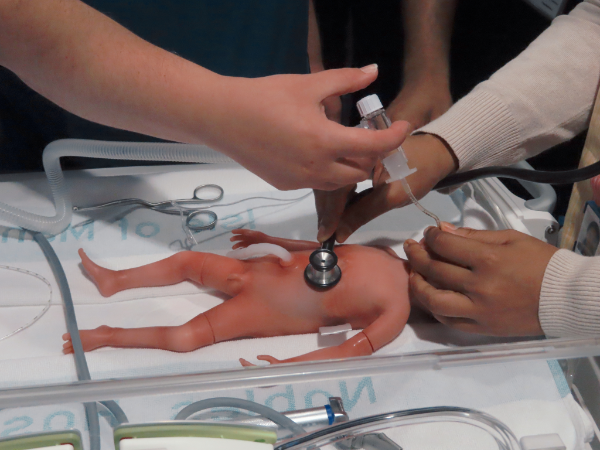
One of the conditions that can affect a premature, and even sometimes a term, baby is Necrotising Enterocolitis (NEC). This is a serious illness in which tissues in the intestine (gut) become inflamed and start to die. One of the warning signs is a distended abdomen and this can be recreated in Paul.
Angela says: ‘Preterm babies born before 37 weeks and even term babies with other medical conditions can have inflammation or infection in their gut and might need to have surgery so it’s all about the management of that kind of situation as well. We’ve never had a manikin before where we can simulate it like this so that’s really exciting for us.
‘What would normally happen is that a baby would appear septic, in septic shock, or start to display signs of that with this kind of condition. So what we’d be doing is intubating the baby and giving it fluids, so it’s that kind of scenario, and then making decisions about moving across to Alder Hey.’
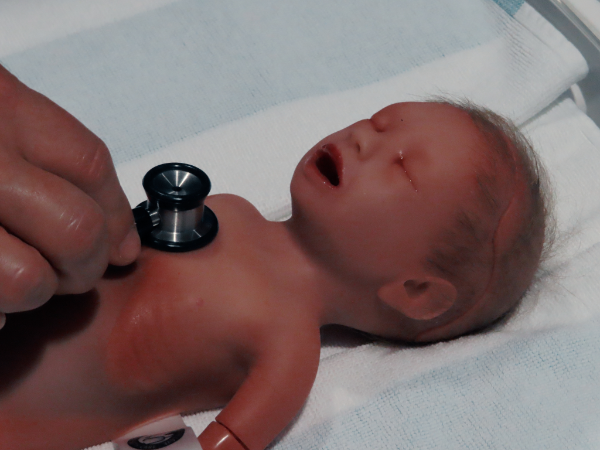
Paul cost the Trust £54,485 and the Unit is sure to get good value from it. The falling birth rate on the island (from nearly 1,000 ten years ago to a predicted 600 this year) means that staff don’t get the same opportunities to carry out various different procedures as they would in a large hospital in the UK. This means that training is especially important for staff here.